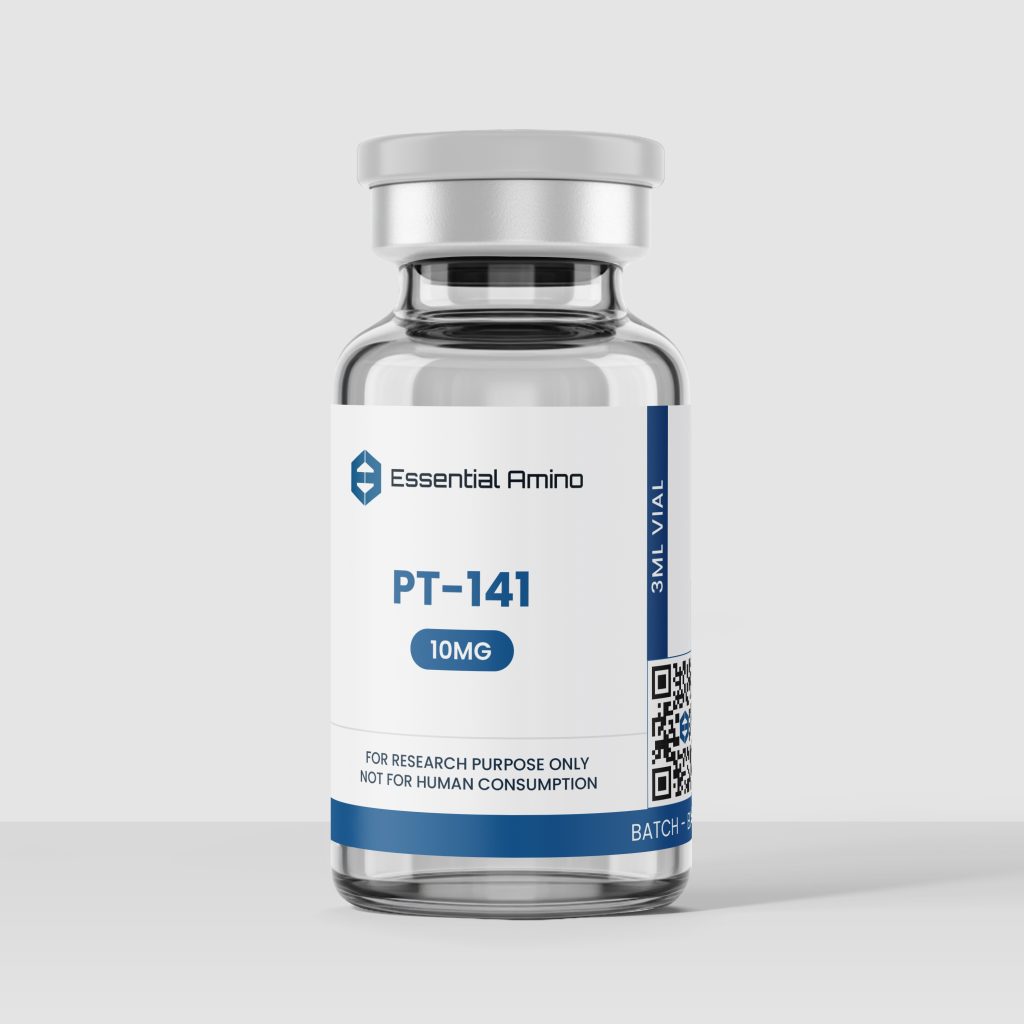
PT-141
What is PT-141?
PT-141 (known chemically as Bremelanotide, Vyleesi, or Ac-Nle-cyclo[Asp-His-D-Phe-Arg-Trp-Lys]-OH) is a synthetic cyclic heptapeptide analog of naturally occurring alpha-melanocyte-stimulating hormone (α-MSH). Structurally derived as a metabolite of Melanotan II (MT-2), PT-141 features a side-chain to side-chain lactam bridge between its aspartic acid and lysine residues that locks the peptide into a highly stable cyclic conformation. Unlike traditional vascular agents that target peripheral blood vessels, PT-141 operates centrally within the central nervous system as a selective melanocortin receptor agonist. Researchers investigate PT-141 for its ability to activate hypothalamic neurons, stimulate mesolimbic dopamine pathways, and modulate neuro-endocrine signaling governing sexual desire and behavioral arousal.
For laboratory and in vitro evaluation, researchers often choose to buy PT-141 in high-purity 10MG lyophilized reference formats. Reconstituted solutions can be securely prepared using sterile laboratory buffers or a specialized reconstitution solution to maintain peptide ring stability and prevent hydrolytic degradation during automated cellular screening protocols.
Chemical and Molecular Data
| Compound Name | PT-141 |
|---|---|
| Quantity / Formats | 10MG (Lyophilized Reference Format) |
| Synonyms / Alt Names | Bremelanotida; PT-141 FREE BASE; PT 141 |
| CAS Number | 189691-06-3 |
| Chemical Formula | C50H68N14O10 |
| Molecular Weight | 1025.2 g/mol |
| IUPAC Name | (3S,6S,9R,12S,15S,23S)-15-[[(2S)-2-acetamidohexanoyl]amino]-9-benzyl-6-[3-(diaminomethylideneamino)propyl]-12-(1H-imidazol-5-ylmethyl)-3-(1H-indol-3-ylmethyl)-2,5,8,11,14,17-hexaoxo-1,4,7,10,13,18-hexazacyclotricosane-23-carboxylic acid |
| InChIKey | FFHBJDQSGDNCIV-MFVUMRCOSA-N |
| SMILES Code | CCCC[C@@H](C(=O)N[C@H]1CC(=O)NCCCC[C@H](NC(=O)[C@@H](NC(=O)[C@@H](NC(=O)[C@H](NC(=O)[C@@H](NC1=O)CC2=CN=CN2)CC3=CC=CC=C3)CCCN=C(N)N)CC4=CNC5=CC=CC=C54)C(=O)O)NC(=O)C |
What are the Mechanisms of Action?
The biochemical pathways and cellular targets of PT-141 include:
- Central Melanocortin Receptor (MC3R / MC4R) Agonism: Research demonstrates that PT-141 acts as a selective agonist at central melanocortin-3 (MC3R) and melanocortin-4 (MC4R) receptors expressed prominently within the medial preoptic area (mPOA) and paraventricular nucleus of the hypothalamus. Activation of these receptors initiates downstream neuro-signaling cascades independent of peripheral vascular mechanisms.
- Mesolimbic Dopamine Pathway Activation: In addition to hypothalamic binding, central MC4R activation by PT-141 stimulates secondary dopamine release within the nucleus accumbens and ventral tegmental area. This dopaminergic activation modulates central reward pathways, enhancing motivational aspects of behavioral arousal.
- Omission of Cutaneous Melanogenesis: Unlike its parent peptide Melanotan II, PT-141 exhibits reduced binding affinity for melanocortin-1 receptors (MC1R) located on dermal melanocytes. This structural divergence isolates central nervous system arousal signaling without triggering significant skin pigmentation or melanogenesis.
What are the Clinical & Preclinical Trials on PT-141?
When evaluating research efficacy and published experimental literature for PT-141:
- Phase 3 Pivotal Clinical Trials (RECONNECT Studies): Multicenter randomized double-blind Phase 3 clinical trials evaluated sub-cutaneously administered bremelanotide in premenopausal subjects with Hypoactive Sexual Desire Disorder (HSDD). The studies demonstrated statistically significant increases in sexual desire scores (measured via the Female Sexual Function Index) and significant reductions in related distress indicators compared to placebo controls.
- Neuro-Functional Brain Imaging & Hypothalamic Activation: Preclinical animal models and human fMRI neuro-imaging studies confirm that PT-141 administration leads to rapid localized neuronal firing within the mPOA and limbic structures, establishing a direct central nervous system mechanism of action. This is often utilized in research involving Oxytocin.
- Safety & Tolerability Profiles: Across clinical trials, PT-141 showcased a consistent safety profile characterized by transient, dose-dependent side effects such as mild nausea and temporary transient elevations in blood pressure that resolved shortly after administration without long-term cardiovascular toxicity.
How does PT-141 compare to other compounds?
To evaluate receptor selectivity, central vs. peripheral mechanisms, and functional research profiles, researchers compare PT-141 against non-selective melanocortin agonists and peripheral vascular agents:
| Compound / Variant | Primary Target & Mechanism | Key Structural Features | Research Profile & Biological Focus |
|---|---|---|---|
| PT-141 (Bremelanotide) | Central MC3R & MC4R Agonist | Cyclic lactam-bridged heptapeptide (Ac-Nle-cyclo[Asp-His-D-Phe-Arg-Trp-Lys]-OH) | Central neuro-endocrine driver of sexual desire and arousal without significant cutaneous melanogenesis |
| Melanotan II (MT-2) | Non-Selective MC1R, MC3R, MC4R, & MC5R Agonist | Cyclic heptapeptide sequence featuring a C-terminal amide cap | Induces central arousal while simultaneously driving cutaneous melanogenesis and skin tanning via strong MC1R activation |
| Tadalafil | Phosphodiesterase-5 (PDE5) Enzyme Inhibitor | Non-peptide small molecule pyrazolopyrimidinone / indole architecture | Acts purely peripherally on vascular smooth muscle to prevent cGMP breakdown and increase localized blood flow, independent of central CNS desire signals |
Frequently Asked Questions (FAQs)
1. What is the structural origin and chemical classification of PT-141?
PT-141 (Bremelanotide) is a synthetic cyclic heptapeptide analog of alpha-melanocyte-stimulating hormone (α-MSH). It is a active metabolite of Melanotan II (MT-2) that features a side-chain to side-chain lactam bridge between the Asp2 and Lys7 residues, providing exceptional conformational stability and resistance to enzymatic cleavage.
2. How does PT-141 differ functionally from Melanotan II (MT-2)?
While Melanotan II is a non-selective agonist that activates MC1R, MC3R, MC4R, and MC5R (causing skin tanning alongside central effects), PT-141 lacks the C-terminal amide structure of MT-2 and exhibits lower affinity for cutaneous MC1R. As a result, PT-141 isolates central MC3R/MC4R arousal pathways without stimulating significant skin pigmentation.
3. How does PT-141’s mechanism differ from PDE5 inhibitors like Sildenafil or Tadalafil?
PDE5 inhibitors act peripherally on vascular smooth muscle by blocking the breakdown of cGMP, thereby enhancing nitric oxide-mediated vasodilation. In contrast, PT-141 acts centrally in the hypothalamus and mesolimbic brain regions via melanocortin receptors to directly stimulate neurological desire and motivational arousal signals.
4. What is the function of the lactam ring structure in PT-141?
The intramolecular lactam bridge between the aspartic acid and lysine side chains locks the peptide into a rigid, cyclic tertiary structure. This cyclic layout protects the internal peptide bonds from rapid exopeptidase degradation in plasma, ensuring high receptor binding duration at central melanocortin sites.
5. What are the proper reconstitution and storage protocols for PT-141?
Lyophilized PT-141 powder should be stored sealed at -20°C for long-term stability. For research application, the peptide should be reconstituted using a sterile solution or dedicated laboratory reconstitution solution. Once reconstituted, liquid solutions must be kept refrigerated at 2°C to 8°C and protected from light to maintain structural peptide integrity.
Disclaimer: All compounds and research materials provided by Essential Aminos are strictly for laboratory and research professional use only. They are not approved for human or animal use nor consumption by the Food and Drug Administration (FDA). These products should not be used for any form of in vivo experimentation or for any other non-laboratory purpose. Any violation or indication of human or animal use will result in immediate removal from being able to purchase products in the future. By purchasing these products, you acknowledge that they will be used exclusively within a controlled and qualified research environment.
Shipping & Returns
Same-Day Dispatch
Orders before 4 PM CT Mon–Fri ship same day. Weekend and holiday orders ship the next business day.
Carriers
U.S. shipping via FedEx. FedEx 2Day $15, FedEx Priority Overnight $60. Free shipping on U.S. orders over $200. Prices exclude tax.
Returns
Returns and exchanges for damaged or defective products only. Contact us within 14 days of delivery with your order number and photos.
Full details: Shipping Policy and Refund Policy.
Disclaimer: All compounds and research materials provided by Essential Aminos are strictly for laboratory and research professional use only. They are not approved for human or animal use nor consumption by the Food and Drug Administration (FDA). These products should not be used for any form of in vivo experimentation or for any other non-laboratory purpose. Any violation or indication of human or animal use will result in immediate removal from being able to purchase products in the future. By purchasing these products, you acknowledge that they will be used exclusively within a controlled and qualified research environment.
Certificate of Analysis
Certificates of analysis are provided for laboratory research reference. Expand a batch below to view the PDF. Only the newest three COAs for this product are listed here.
PT-141 10mg 10MG - Lot / Batch: BX-P-J9K1
- Average Purity: 99.93%
- Endotoxin Threshold Results: Pass
- Lot#: BX-P-J9K1
- Search Code: esse2608060890
Search all COAs by batch number (includes older batches not shown above).