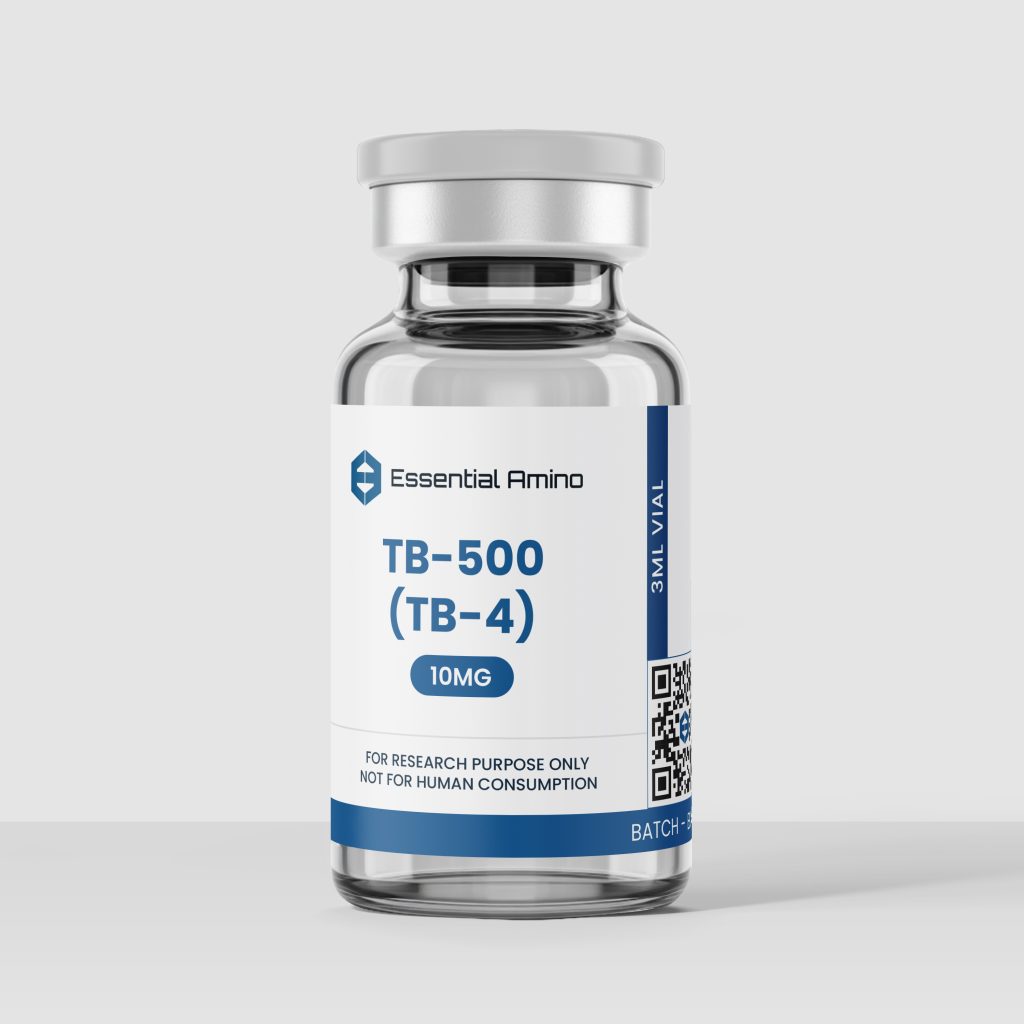
TB-500 (TB-4)
What is Thymosin Beta-4?
Thymosin Beta-4 (known chemically as Tβ4, Thymosin β4, or FX Peptide) is a naturally occurring, highly conserved 43-amino acid peptide encoded by the TMSB4X gene. Originally isolated from bovine thymus tissue, Tβ4 is the primary actin-sequestering molecule present in human blood platelets, wound fluid, and tissue cytoplasm. Featuring an N-terminal acetylated serine residue (`Ac-SDKPDMAEIEKFDKSKLKKTETQEKNPLPSKETIEQEKQAGES-OH`), Thymosin Beta-4 regulates cell migration, endothelial sprouting, tissue remodeling, and inflammatory suppression following acute injury.
For laboratory and in vitro evaluation, researchers often choose to buy Thymosin Beta-4 in high-purity lyophilized reference formats. Reconstituted solutions can be securely prepared using sterile laboratory buffers or a specialized reconstitution solution to ensure structural stability and prevent peptide degradation during automated cellular screening protocols.
Chemical and Molecular Data
| Compound Name | TB-500 (TB-4) |
|---|---|
| Quantity / Formats | 2MG / 5MG / 10MG (Lyophilized Reference Formats) |
| Synonyms / Alt Names | TB500; TB-500; Ac-Leu-Lys-Lys-Thr-Glu-Thr-Gln-OH |
| CAS Number | 885340-08-9 |
| Chemical Formula | C38H68N10O14 |
| Molecular Weight | 889.0 g/mol |
| IUPAC Name | (2S)-2-[[(2S,3R)-2-[[(2S)-2-[[(2S,3R)-2-[[(2S)-2-[[(2S)-2-[[(2S)-2-acetamido-4-methylpentanoyl]amino]-6-aminohexanoyl]amino]-6-aminohexanoyl]amino]-3-hydroxybutanoyl]amino]-4-carboxybutanoyl]amino]-3-hydroxybutanoyl]amino]-5-amino-5-oxopentanoic acid |
| InChIKey | ADKDNDYYIZUVCZ-ZQNQAVPYSA-N |
| SMILES Code | C[C@H]([C@@H](C(=O)N[C@@H](CCC(=O)O)C(=O)N[C@@H]([C@@H](C)O)C(=O)N[C@@H](CCC(=O)N)C(=O)O)NC(=O)[C@H](CCCCN)NC(=O)[C@H](CCCCN)NC(=O)[C@H](CC(C)C)NC(=O)C)O |
What are the Mechanisms of Action?
The biochemical pathways and cellular targets of Thymosin Beta-4 include:
- G-Actin Monomer Sequestration: Research demonstrates that Tβ4 binds in a 1:1 ratio with monomeric actin (G-actin), preventing its spontaneous assembly into filamentous actin (F-actin). This dynamic pool maintenance allows cells to rapidly mobilize actin subunits to cell margins, driving lamellipodia formation, chemotaxis, and cell migration into damaged tissue sites.
- Angiogenesis & Endothelial Cell Sprouting: In addition to cytoskeletal control, Tβ4 promotes capillary vessel formation by stimulating endothelial cell migration and upregulating vascular endothelial growth factor (VEGF) signaling. This accelerates capillary sprouting and re-vascularization across ischemic tissue environments.
- Anti-Inflammatory & Anti-Fibrotic Cascades: Studies indicate that Tβ4 inhibits nuclear factor kappa B (NF-κB) phosphorylation, dampening the release of pro-inflammatory cytokines (such as TNF-α and IL-1β). It simultaneously downregulates myofibroblast differentiation, reducing excessive collagen deposition and preventing hyper-fibrotic scar formation.
What are the Clinical & Preclinical Trials on Thymosin Beta-4?
When evaluating research efficacy and published experimental literature for Thymosin Beta-4:
- Dermal Wound Healing & Corneal Repair Trials: Multicenter Phase 2 clinical trials evaluated topical and systemic Tβ4 formulations in chronic pressure ulcers and corneal epithelial defects. Results confirmed significantly accelerated wound closure times, enhanced re-epithelialization rates, and minimal scar tissue formation compared to placebo controls.
- Cardiac Remodeling & Post-Infarction Rescue Models: Preclinical rodent and porcine models of acute myocardial infarction demonstrated that post-ischemic Tβ4 administration mobilizes epicardial progenitor cells, reduces cardiac cell apoptosis, limits infarct scar volume, and preserves baseline left ventricular ejection fraction.
- Toxicological Safety & Systemic Tolerability: Comprehensive safety evaluations across human Phase 1-2 trials confirm that Thymosin Beta-4 possesses a broad therapeutic window with no observed dose-limiting toxicity, organ accumulation, or oncogenic transformation.
How does Thymosin Beta-4 compare to other compounds?
To evaluate sequence completeness, tissue distribution mechanics, and functional repair profiles, researchers compare full-length Thymosin Beta-4 against short synthetic fragments and alternative gastric repair peptides:
| Compound / Variant | Primary Target & Mechanism | Structural Length / Sequence | Research Focus & Biological Profile |
|---|---|---|---|
| Thymosin Beta-4 | G-Actin Sequestration, VEGF Angiogenesis & NF-κB Suppression | Full 43-amino acid native sequence (Ac-SDKPDMAEIEKFDKSKLKKTETQEKNPLPSKETIEQEKQAGES-OH) | Complete native protein providing full-spectrum tissue repair, multi-organ angiogenesis, cardioprotection, and anti-fibrotic remodeling |
| TB-500 (Active Fragment) | G-Actin Binding Domain (LKKTETQ Region) | Truncated 7-amino acid active fragment sequence (`Ac-LKKTETQ-NH2`) | Isolated synthetic fragment specifically engineered to focus on actin binding, endothelial cell migration, and rapid localized soft tissue repair |
| BPC-157 | VEGFR2 Activation, Nitric Oxide (NO) Synthesis & FAK Phosphorylation | Synthetic 15-amino acid gastric pentadecapeptide sequence | Focuses primarily on tendon-to-bone reattachment, gut mucosal integrity, and nitric oxide-mediated vascular repair, operating independently of actin sequestration pathways |
Frequently Asked Questions (FAQs)
1. What is the structural difference between Thymosin Beta-4 and TB-500?
Thymosin Beta-4 is the full-length, naturally occurring 43-amino acid protein. In contrast, “TB-500” often refers commercially to the short 7-amino acid active peptide fragment (Ac-LKKTETQ-NH2) representing the core actin-binding site of the larger Tβ4 molecule.
2. How does Thymosin Beta-4 regulate the cell cytoskeleton via G-actin?
Tβ4 binds in a 1:1 complex with unpolymerized globular actin (G-actin), preventing it from assembling into actin filaments (F-actin). This maintains a high concentration of mobile actin monomers within the cell cytosol, allowing rapid directional filament assembly at leading cell edges during cell migration and tissue repair.
3. What role does Thymosin Beta-4 play in cardiac tissue research following ischemic injury?
In post-myocardial infarction models, Tβ4 promotes cardiomyocyte survival, mobilizes resident epicardial progenitor cells to differentiate into vascular endothelial cells, reduces collagen scar tissue density, and helps preserve left ventricular ejection fraction.
4. How does Thymosin Beta-4 limit excessive scar tissue formation?
Tβ4 suppresses the activation of nuclear factor kappa B (NF-κB) and downregulates connective tissue growth factor (CTGF), preventing excess myofibroblast differentiation and reducing disorganized collagen deposition during wound healing.
5. What are the proper reconstitution and storage protocols for Thymosin Beta-4?
Lyophilized Thymosin Beta-4 powder should be stored sealed at -20°C for long-term stability. For research use, the peptide should be reconstituted using a sterile solution or dedicated laboratory reconstitution solution. Once reconstituted, liquid solutions must be kept refrigerated at 2°C to 8°C and protected from light to maintain structural peptide integrity.
Shipping & Returns
Same-Day Dispatch
Orders before 4 PM CT Mon–Fri ship same day. Weekend and holiday orders ship the next business day.
Carriers
U.S. shipping via FedEx. FedEx 2Day $15, FedEx Priority Overnight $60. Free shipping on U.S. orders over $200. Prices exclude tax.
Returns
Returns and exchanges for damaged or defective products only. Contact us within 14 days of delivery with your order number and photos.
Full details: Shipping Policy and Refund Policy.
Disclaimer: All compounds and research materials provided by Essential Aminos are strictly for laboratory and research professional use only. They are not approved for human or animal use nor consumption by the Food and Drug Administration (FDA). These products should not be used for any form of in vivo experimentation or for any other non-laboratory purpose. Any violation or indication of human or animal use will result in immediate removal from being able to purchase products in the future. By purchasing these products, you acknowledge that they will be used exclusively within a controlled and qualified research environment.
Certificate of Analysis
Certificates of analysis are provided for laboratory research reference. Expand a batch below to view the PDF. Only the newest three COAs for this product are listed here.
TB-500 10MG - Lot / Batch: BX-P-Y5C8
- Mass Identification: Thymosin Beta-4, Confirmed
- Average Net Peptide: 9.79 mg
- Average Purity: 99.48%
- Endotoxin Threshold Results: Pass (Assay sensitivity ≤0.05 EU/mL; Replicate 1 Pass, Replicate 2 Pass)
- Lot#: BX-P-Y5C8
- Search Code: Esse2608050856
Search all COAs by batch number (includes older batches not shown above).