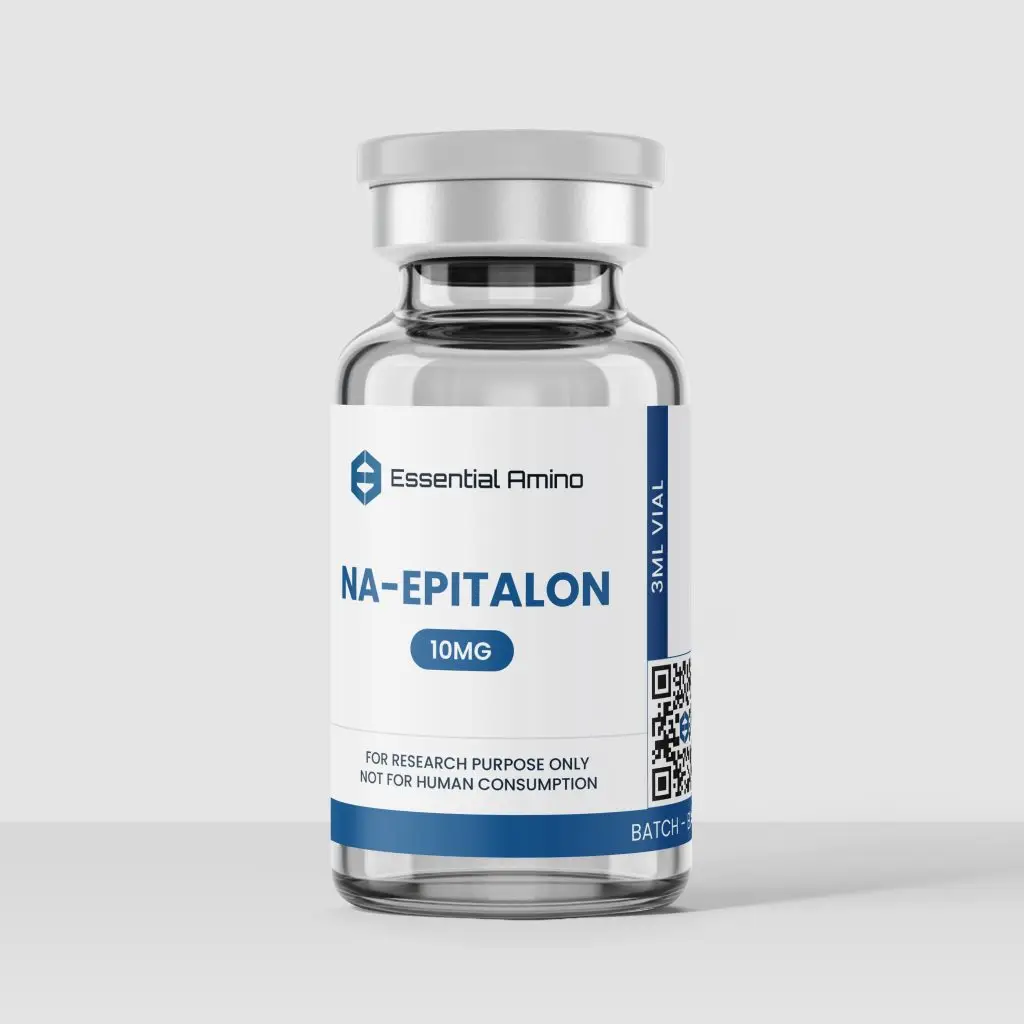
NA-Epitalon
What is NA-Epitalon?
NA-Epitalon (known chemically as N-Acetyl Epitalon or N-Acetyl Epithalon) is an advanced, N-terminally acetylated derivative of the synthetic pineal tetrapeptide Epitalon (L-alanyl-L-alpha-glutamyl-L-alpha-aspartylglycine). Originally synthesized based on the naturally occurring bovine pineal gland extract Epithalamin, NA-Epitalon features an N-terminal acetyl group modification. This structural capping shields the peptide from early breakdown by systemic aminopeptidases, significantly extending its biological half-life and enhancing its ability to cross cell membranes. Researchers investigate NA-Epitalon for its ability to activate telomerase gene expression, promote telomere elongation, restore circadian melatonin secretion patterns, and reduce cellular senescence markers in aging tissue models.
For laboratory and in vitro evaluation, researchers often choose to buy NA-Epitalon in high-purity lyophilized reference formats. Reconstituted solutions can be securely prepared using sterile laboratory buffers or a specialized reconstitution solution to ensure complete molecular stability and prevent hydrolytic degradation during automated cellular assays.
Chemical and Molecular Data
| Compound Name | NA-Epitalon |
|---|---|
| Quantity / Formats | 10MG / 20MG / 50MG (Lyophilized Reference Formats) |
| Synonyms / Alt Names | Epithalon; Epithalone; Ala-Glu-Asp-Gly |
| CAS Number | 307297-39-8, 64082-79-7 |
| Chemical Formula | C14H22N4O9 |
| Molecular Weight | 390.35 g/mol |
| IUPAC Name | (4S)-4-[[(2S)-2-aminopropanoyl]amino]-5-[[(2S)-3-carboxy-1-(carboxymethylamino)-1-oxopropan-2-yl]amino]-5-oxopentanoic acid |
| InChIKey | HGHOBRRUMWJWCU-FXQIFTODSA-N |
| SMILES Code | C[C@@H](C(=O)N[C@@H](CCC(=O)O)C(=O)N[C@@H](CC(=O)O)C(=O)NCC(=O)O)N |
What are the Mechanisms of Action?
The biochemical pathways and cellular targets of NA-Epitalon include:
- Telomerase Activation & Telomere Elongation: Research demonstrates that NA-Epitalon induces the expression of the human telomerase reverse transcriptase (hTERT) catalytic subunit. By activating enzymatic telomerase, the peptide promotes the elongation of repetitive TTAGGG nucleotide sequences at chromosome ends, extending the Hayflick limit of somatic cells and delaying replicative senescence.
- Pineal Gland Neuro-Endocrine Restoration: In addition to telomeric regulation, NA-Epitalon targets the pineal gland to restore nocturnal melatonin synthesis and secretion. It upregulates key enzymes in the tryptophan-melatonin pathway, re-entraining circadian rhythms and dampening neuro-endocrine stress responses.
- Chromatin Uncondensing & Epigenetic Modulation: Studies indicate that NA-Epitalon interacts directly with specific promoter regions of DNA and histone proteins. This interaction induces chromatin decondensation, restoring youthful gene expression patterns, enhancing DNA repair machinery, and mitigating oxidative double-strand break accumulation.
What are the Clinical & Preclinical Trials on NA-Epitalon?
When evaluating research efficacy and published experimental literature for NA-Epitalon:
- Somatic Cell Life-Span & Telomerase Assays: In vitro studies on cultured human somatic cells confirm that treatment with Epitalon analogs induces telomerase activity, leading to measurable telomere lengthening and allowing treated cell cultures to exceed their standard Hayflick division limit by up to 10 additional passages compared to untreated control groups.
- Circadian Entrainment & Melatonin Dynamics: Preclinical investigations evaluating aging animal models showed that administration of pineal peptides restored nocturnal plasma melatonin levels to youthful baselines, normalizing metabolic parameters, suppressing spontaneous tumor development, and extending mean lifespan.
- Peptidase Resistance & Extended Half-Life Screening: Comparative analytical assays confirm that N-terminal acetylation prevents recognition and cleavage by circulating serum aminopeptidases. This modification significantly increases functional peptide half-life in physiological media compared to un-capped native Epitalon.
How does NA-Epitalon compare to other compounds?
To evaluate enzymatic stability, blood-brain barrier permeability, and functional longevity profiles, researchers compare NA-Epitalon against native Epitalon, amidated derivatives, and short bioregulatory tripeptides:
| Compound / Variant | Primary Mechanism / Modification | Enzymatic Stability & Permeability | Biological Focus & Research Profile |
|---|---|---|---|
| NA-Epitalon | Addition of an N-terminal acetyl group (Ac-Ala-Glu-Asp-Gly-OH) | Shielded against N-terminal aminopeptidases; enhanced lipophilicity and membrane transit | Optimized version of Epitalon designed for extended half-life, telomerase activation, and pineal gland restoration |
| Epitalon (Native) | Unmodified short tetrapeptide sequence (Ala-Glu-Asp-Gly) | Standard peptide stability; subject to rapid degradation by circulating exopeptidases | Original benchmark tetrapeptide for telomere research, cellular senescence reduction, and circadian restoration |
| Epitalon-Amidate | Addition of a C-terminal amide group (Ala-Glu-Asp-Gly-NH2) | Shielded against C-terminal carboxypeptidases; moderate overall metabolic stability | Protects the C-terminus from cleavage, maintaining structural charge neutrality and enhancing receptor binding duration |
| NA-Epitalon-Amidate | Dual-capped sequence featuring N-terminal acetylation and C-terminal amidation (Ac-Ala-Glu-Asp-Gly-NH2) | Maximum resistance to both aminopeptidases and carboxypeptidases; highest metabolic half-life | Fully protected terminal configuration offering the longest duration of action and highest central bioactivity among Epitalon derivatives |
| Pinealon | Synthetic neuro-protective tripeptide sequence (Glu-Asp-Arg) | Short, highly stable tripeptide architecture with rapid cellular uptake | Focuses primarily on central nervous system protection, ROS suppression in brain tissue, and cognitive impairment prevention rather than systemic telomerase activation |
Frequently Asked Questions (FAQs)
1. How does NA-Epitalon differ structurally from native Epitalon?
NA-Epitalon contains an N-terminal acetyl group attached to the alanine residue of the native Epitalon tetrapeptide sequence (Ala-Glu-Asp-Gly). This acetylation masks the positive charge on the N-terminus, increasing the overall lipophilicity of the molecule and shielding it from degradation by circulating aminopeptidases.
2. Why is N-terminal acetylation beneficial for peptide stability in research?
In biological media and blood plasma, un-capped peptides are rapidly degraded by exopeptidases—specifically aminopeptidases that cleave amino acids from the N-terminus. Acetylation acts as a chemical end-cap that blocks aminopeptidase binding, significantly extending the functional half-life and cellular availability of the peptide during experimental trials.
3. What role does NA-Epitalon play in telomerase activation and cellular aging?
NA-Epitalon stimulates the expression of the hTERT gene, which encodes the catalytic subunit of the enzyme telomerase. Activated telomerase synthesizes new telomeric repeats at the ends of chromosomes, preventing progressive telomere shortening during cell division and delaying the onset of replicative cellular senescence.
4. How does NA-Epitalon interact with the pineal gland and circadian rhythm pathways?
NA-Epitalon mimics the signaling properties of pineal-derived peptide extracts, upregulating enzymes responsible for serotonin-to-melatonin conversion in the pineal gland. This helps restore natural, nocturnal melatonin secretion peaks and re-entrains disrupted circadian rhythm networks in aging or stressed biological models.
5. What are the proper reconstitution and storage protocols for NA-Epitalon?
Lyophilized NA-Epitalon powder should be stored sealed at -20°C for long-term stability. For research use, the powder should be reconstituted with a sterile solution or dedicated laboratory buffer. Once in liquid form, the solution must be stored refrigerated between 2°C and 8°C and protected from light to maintain structural integrity.
Shipping & Returns
Same-Day Dispatch
Orders before 4 PM CT Mon–Fri ship same day. Weekend and holiday orders ship the next business day.
Carriers
U.S. shipping via FedEx. FedEx 2Day $15, FedEx Priority Overnight $60. Free shipping on U.S. orders over $200. Prices exclude tax.
Returns
Returns and exchanges for damaged or defective products only. Contact us within 14 days of delivery with your order number and photos.
Full details: Shipping Policy and Refund Policy.
Disclaimer: All compounds and research materials provided by Essential Aminos are strictly for laboratory and research professional use only. They are not approved for human or animal use nor consumption by the Food and Drug Administration (FDA). These products should not be used for any form of in vivo experimentation or for any other non-laboratory purpose. Any violation or indication of human or animal use will result in immediate removal from being able to purchase products in the future. By purchasing these products, you acknowledge that they will be used exclusively within a controlled and qualified research environment.
Certificate of Analysis
Certificates of analysis are provided for laboratory research reference. Expand a batch below to view the PDF. Only the newest three COAs for this product are listed here.
No certificate of analysis is currently linked to this product. Search by batch number on the COA Search page.