Thymosin Alpha-1
What is Thymosin Alpha-1?
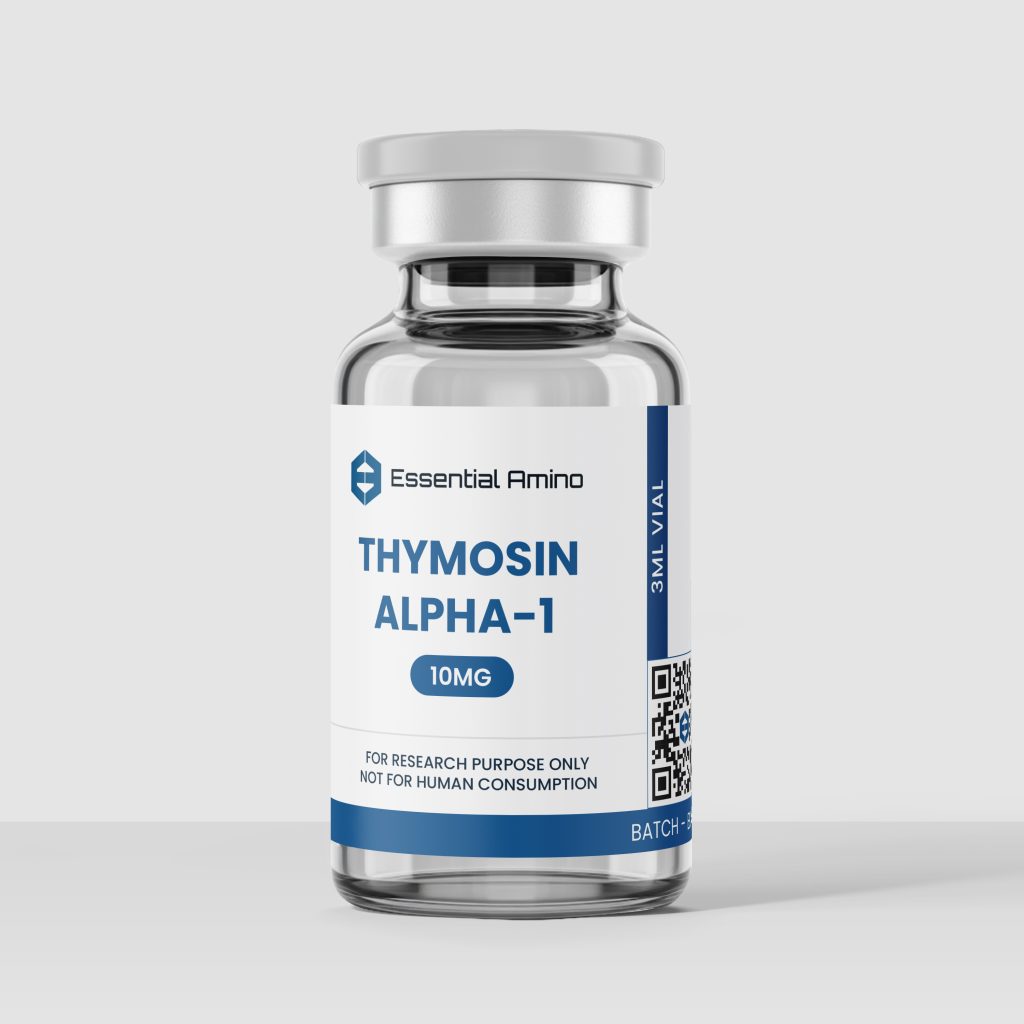
Thymosin Alpha-1 (known chemically as Tα1, Thymalfasin, or Zadaxin) is a naturally occurring, highly conserved 28-amino acid peptide derived from prothymosin alpha. Originally isolated from bovine thymus gland tissue (Thymosin Fraction 5), Tα1 features an N-terminal acetylated serine residue (`Ac-SDAAVDTSSEITTKDLKEKKEVVEEAEN-OH`). Unlike tissue-repair peptides that target structural extracellular matrices, Thymosin Alpha-1 functions as an immune system enhancer and biological response modifier. Researchers investigate Tα1 for its ability to stimulate T-cell maturation, upregulate Toll-like receptor signaling, enhance natural killer (NK) cell activity, and re-establish immune homeostasis in immunocompromised or virally challenged tissue models.
For laboratory and in vitro evaluation, researchers often choose to buy Thymosin Alpha-1 in high-purity lyophilized reference formats. Reconstituted solutions can be securely prepared using sterile laboratory buffers or a specialized reconstitution solution to maintain peptide structural stability and prevent hydrolytic degradation during automated cellular screening protocols.
Chemical and Molecular Data
| Compound Name | Thymosin Alpha-1 |
|---|---|
| Quantity / Formats | 2MG / 5MG / 10MG (Lyophilized Reference Formats) |
| Synonyms / Alt Names | Thymalfasin; Thymosin alpha 1; Thymosin alpha1 |
| CAS Number | 62304-98-7, 69521-94-4, 1337515-90-8 |
| Chemical Formula | C129H215N33O55 |
| Molecular Weight | 3108.3 g/mol |
| IUPAC Name | (4S)-4-[[(2S)-2-[[(2S)-2-[[(2S)-2-[[(2S)-2-[[(2S)-2-[[(2S)-2-[[(2S)-2-[[(2S)-2-[[(2S)-2-[[(2S)-2-[[(2S)-2-[[(2S)-2-[[(2S)-2-[[(2S,3R)-2-[[(2S,3R)-2-[[(2S,3S)-2-[[(2S)-2-[[(2S)-2-[[(2S)-2-[[(2S,3R)-2-[[(2S)-2-[[(2S)-2-[[(2S)-2-[[(2S)-2-[[(2S)-2-[[(2S)-2-acetamido-3-hydroxypropanoyl]amino]-3-carboxypropanoyl]amino]propanoyl]amino]propanoyl]amino]-3-methylbutanoyl]amino]-3-carboxypropanoyl]amino]-3-hydroxybutanoyl]amino]-3-hydroxypropanoyl]amino]-3-hydroxypropanoyl]amino]-4-carboxybutanoyl]amino]-3-methylpentanoyl]amino]-3-hydroxybutanoyl]amino]-3-hydroxybutanoyl]amino]-6-aminohexanoyl]amino]-3-carboxypropanoyl]amino]-4-methylpentanoyl]amino]-6-aminohexanoyl]amino]-4-carboxybutanoyl]amino]-6-aminohexanoyl]amino]-6-aminohexanoyl]amino]-4-carboxybutanoyl]amino]-3-methylbutanoyl]amino]-3-methylbutanoyl]amino]-4-carboxybutanoyl]amino]-4-carboxybutanoyl]amino]propanoyl]amino]-5-[[(1S)-3-amino-1-carboxy-3-oxopropyl]amino]-5-oxopentanoic acid |
| InChIKey | NZVYCXVTEHPMHE-ZSUJOUNUSA-N |
| SMILES Code | CC[C@H](C)[C@@H](C(=O)N[C@@H]([C@@H](C)O)C(=O)N[C@@H]([C@@H](C)O)C(=O)N[C@@H](CCCCN)C(=O)N[C@@H](CC(=O)O)C(=O)N[C@@H](CC(C)C)C(=O)N[C@@H](CCCCN)C(=O)N[C@@H](CCC(=O)O)C(=O)N[C@@H](CCCCN)C(=O)N[C@@H](CCCCN)C(=O)N[C@@H](CCC(=O)O)C(=O)N[C@@H](C(C)C)C(=O)N[C@@H](C(C)C)C(=O)N[C@@H](CCC(=O)O)C(=O)N[C@@H](CCC(=O)O)C(=O)N[C@@H](C)C(=O)N[C@@H](CCC(=O)O)C(=O)N[C@@H](CC(=O)N)C(=O)O)NC(=O)[C@H](CCC(=O)O)NC(=O)[C@H](CO)NC(=O)[C@H](CO)NC(=O)[C@H]([C@@H](C)O)NC(=O)[C@H](CC(=O)O)NC(=O)[C@H](C(C)C)NC(=O)[C@H](C)NC(=O)[C@H](C)NC(=O)[C@H](CC(=O)O)NC(=O)[C@H](CO)NC(=O)C |
What are the Mechanisms of Action?
The biochemical pathways and cellular targets of Thymosin Alpha-1 include:
- Toll-Like Receptor (TLR-7 & TLR-9) Activation: Research demonstrates that Tα1 acts as an agonist at TLR-7 and TLR-9 on immature myeloid and plasmacytoid dendritic cells. This interaction triggers MyD88-dependent signaling cascades, driving dendritic cell maturation and initiating antigen presentation machinery.
- T-Cell Lineage Differentiation & Maturation: In addition to innate signaling, Tα1 promotes the differentiation of early thymic progenitor cells into mature CD4+ helper and CD8+ cytotoxic T-lymphocytes. It simultaneously boosts interleukin-2 (IL-2) expression and high-affinity IL-2 receptor signaling, expanding active lymphocyte populations.
- MHC Class I & Cytokine Modulation: Studies indicate that Tα1 upregulates Major Histocompatibility Complex (MHC) Class I and glutathione expression in virus-infected and malignant cell lines. It balances pro- and anti-inflammatory pathways by increasing Interferon-gamma (IFN-γ) while suppressing hyper-inflammatory IL-6 and TNF-α spikes under systemic stress.
What are the Clinical & Preclinical Trials on Thymosin Alpha-1?
When evaluating research efficacy and published experimental literature for Thymosin Alpha-1:
- Viral Hepatitis & Immunotherapy Clinical Trials: Human clinical trials evaluating Thymalfasin in chronic Hepatitis B (HBV) and Hepatitis C (HCV) models demonstrated significant viral load clearance, sustained biochemical response rates, and normalized alanine aminotransferase (ALT) metrics when combined with standard antiviral protocols.
- Sepsis & Immunosuppression Recovery Assays: Multicenter randomized trials in severe sepsis models confirmed that Tα1 administration restored depressed HLA-DR expression on monocytes, reduced 28-day mortality rates, and accelerated lymphocyte recovery following sepsis-induced immune exhaustion.
- Toxicology & Systemic Safety Profile: Extensive toxicology profiles across human Phase 1-3 clinical trials confirm that Thymosin Alpha-1 exhibits exceptional tolerability with an absence of serious adverse events, bone marrow suppression, or systemic organ toxicity.
How does Thymosin Alpha-1 compare to other compounds?
To evaluate receptor targeting, functional pathways, and biological profiles, researchers compare Thymosin Alpha-1 against its structural sibling Thymosin Beta-4 and host-defense antimicrobial peptides:
| Compound / Variant | Primary Mechanism & Pathway | Sequence Length & Structure | Research Focus & Biological Profile |
|---|---|---|---|
| Thymosin Alpha-1 | TLR-7/9 Activation, T-Cell Maturation & MHC Class I Upregulation | 28-amino acid sequence (`Ac-SDAAVDTSSEITTKDLKEKKEVVEEAEN-OH`) | Primary immune system enhancer; focuses on adaptive immunity, viral defense, and dendritic cell maturation |
| Thymosin Beta-4 | G-Actin Monomer Sequestration, Angiogenesis & NF-κB Suppression | 43-amino acid sequence (`Ac-SDKPDMAEIEKFDKSKLKKTETQEKNPLPSKETIEQEKQAGES-OH`) | Primary tissue repair peptide; focuses on cell migration, wound healing, vascular sprouting, and anti-fibrotic tissue remodeling |
| LL-37 | Direct Microbial Membrane Disruption & LPS Neutralization | 37-amino acid amphipathic cathelicidin peptide fragment | Host-defense peptide targeting bacterial outer membranes and biofilm clearance, acting as a direct antimicrobial agent rather than an adaptive T-cell modulator |
Frequently Asked Questions (FAQs)
1. What is the structural origin and chemical classification of Thymosin Alpha-1?
Thymosin Alpha-1 (Tα1) is a 28-amino acid synthetic peptide corresponding to the N-terminal fragment of prothymosin alpha. It features an acetylated N-terminal serine residue that protects the peptide from immediate degradation by circulating plasma exopeptidases.
2. How does Thymosin Alpha-1 differ fundamentally from Thymosin Beta-4?
Although both were originally isolated from thymic tissue extracts, they serve entirely different biological functions. Thymosin Alpha-1 regulates adaptive immune responses, T-cell maturation, and dendritic cell signaling. In contrast, Thymosin Beta-4 regulates cell cytoskeleton dynamics, actin monomer sequestration, angiogenesis, and wound tissue repair.
3. Through what innate immune pathways does Thymosin Alpha-1 operate?
Tα1 acts as an agonist at Toll-like receptors 7 and 9 (TLR-7/TLR-9) on plasmacytoid and myeloid dendritic cells. Activation triggers the MyD88 signaling cascade, promoting dendritic cell maturation, upregulation of co-stimulatory molecules, and initiation of primary immune responses.
4. What effect does Thymosin Alpha-1 have on adaptive T-lymphocytes and Natural Killer cells?
Tα1 accelerates the differentiation of double-negative thymocytes into mature CD4+ and CD8+ T-cells. It increases endogenous interleukin-2 (IL-2) and interferon-gamma (IFN-γ) expression, enhancing cytotoxic T-lymphocyte (CTL) responses and natural killer (NK) cell lytic activity.
5. What are the proper reconstitution and storage protocols for Thymosin Alpha-1?
Lyophilized Thymosin Alpha-1 powder should be stored sealed at -20°C for long-term stability. For research use, the peptide should be reconstituted using a sterile solution or dedicated laboratory reconstitution solution. Once reconstituted, liquid solutions must be kept refrigerated at 2°C to 8°C and protected from light to maintain structural peptide integrity.
Shipping & Returns
Same-Day Dispatch
Orders before 4 PM CT Mon–Fri ship same day. Weekend and holiday orders ship the next business day.
Carriers
U.S. shipping via FedEx. FedEx 2Day $15, FedEx Priority Overnight $60. Free shipping on U.S. orders over $200. Prices exclude tax.
Returns
Returns and exchanges for damaged or defective products only. Contact us within 14 days of delivery with your order number and photos.
Full details: Shipping Policy and Refund Policy.
Disclaimer: All compounds and research materials provided by Essential Aminos are strictly for laboratory and research professional use only. They are not approved for human or animal use nor consumption by the Food and Drug Administration (FDA). These products should not be used for any form of in vivo experimentation or for any other non-laboratory purpose. Any violation or indication of human or animal use will result in immediate removal from being able to purchase products in the future. By purchasing these products, you acknowledge that they will be used exclusively within a controlled and qualified research environment.
Certificate of Analysis
Certificates of analysis are provided for laboratory research reference. Expand a batch below to view the PDF. Only the newest three COAs for this product are listed here.
Thymosin Alpha-1 10MG - Lot / Batch: BX-P-V3N7
- Mass Identification: Thymosin Alpha-1 confirmed
- Average Net Peptide: 12.74 mg
- Average Purity: 99.76%
- Endotoxin Threshold Results: Pass (assay sensitivity ≤0.05 EU/mL, both replicates Pass)
- Lot#: BX-P-V3N7
- Search Code: Esse2609020921
Search all COAs by batch number (includes older batches not shown above).