Glutathione
What is Glutathione?
Glutathione (known chemically as Reduced Glutathione or GSH) is an endogenous, low-molecular-weight tripeptide composed of glutamate, cysteine, and glycine. Widely recognized as the primary intracellular “master antioxidant,” it is present in high concentrations across almost all cellular tissues. Researchers investigate this compound for its fundamental role in neutralizing reactive oxygen species (ROS), protecting mitochondrial DNA from oxidative decay, and driving Phase II hepatic detoxification pathways.
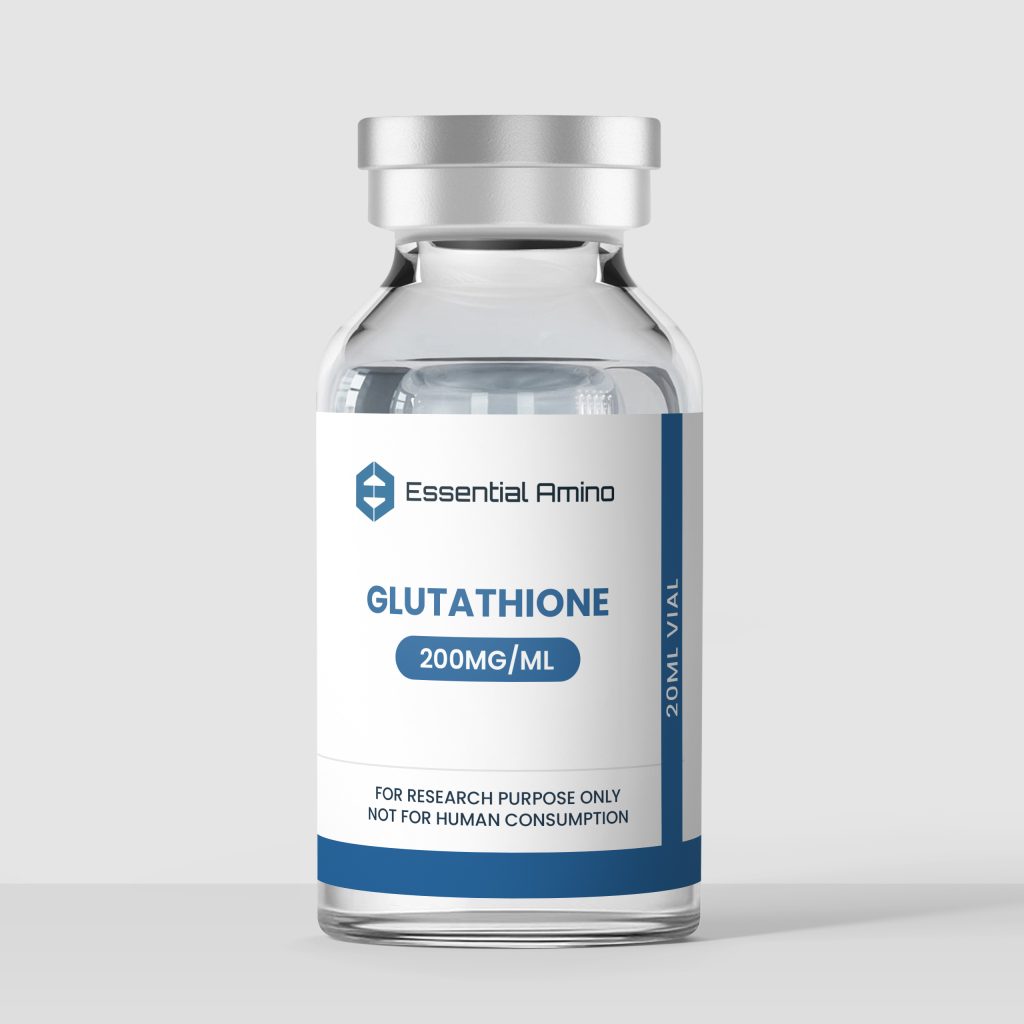
For laboratory and in vitro evaluation, researchers often choose to buy Glutathione in high-purity 600MG / 1500MG lyophilized powder formats, or as a pre-solubilized 200MG/ML liquid compound. Because the liquid matrix is highly susceptible to atmospheric oxidation, the 200MG/ML presentation must be stored under continuous refrigeration to preserve its active, reduced state and prevent structural degradation into its inactive disulfide form (GSSG). Lyophilized powders can be securely prepared using specialized reconstitution solution to ensure structural stability right before assay deployment.
Chemical and Molecular Data
| Compound Name | Glutathione |
|---|---|
| Quantity / Formats | 600MG / 1500MG (Lyophilized) | 200MG/ML (Liquid – Requires Refrigeration) |
| Synonyms / Alt Names | L-Glutathione reduced; L-Glutathione; Glutathion |
| CAS Number | 70-18-8, 106272-20-2 |
| Chemical Formula | C10H17N3O6S |
| Molecular Weight | 307.33 g/mol |
| IUPAC Name | (2S)-2-amino-5-[[(2R)-1-(carboxymethylamino)-1-oxo-3-sulfanylpropan-2-yl]amino]-5-oxopentanoic acid |
| InChIKey | RWSXRVCMGQZWBV-WDSKDSINSA-N |
| SMILES Code | C(CC(=O)N[C@@H](CS)C(=O)NCC(=O)O)[C@@H](C(=O)O)N |
What are the Mechanisms of Action?
The biochemical pathways and cellular targets of Glutathione include:
- Direct Electrophilic Scavenging: Research demonstrates that the active sulfhydryl (-SH) group on the cysteine residue serves as a strong electron donor. This enables GSH to directly reduce free radicals and reactive oxygen species (ROS), such as hydroxyl radicals and hydrogen peroxide, converting them into harmless baseline metabolic bioproducts.
- Enzymatic Co-substrate Activation: In addition to direct radical neutralization, Glutathione serves as an obligatory co-substrate for Glutathione Peroxidase (GPx) enzymes. This specific interaction catalyzes the reduction of damaging lipid hydroperoxides, preserving the structural integrity of cellular lipid bilayers.
- Phase II Xenobiotic Conjugation: Studies indicate that GSH acts as a primary substrate for Glutathione S-Transferase (GST) enzymes. Within hepatic tissue assays, GST catalyzes the conjugation of reduced Glutathione onto hydrophobic xenobiotics and electrophilic toxins, rendering them highly water-soluble for cellular excretion.
What are the Clinical & Preclinical Trials on Glutathione?
When evaluating research efficacy and published experimental literature:
- Hepatic Integrity and Toxic Mitigation: Preclinical models evaluating chemically induced hepatotoxicity demonstrated that targeted administration of reduced GSH completely preserves mitochondrial membrane potentials. It directly limits intracellular lipid peroxidation and maintains baseline tissue metabolic capacity under heavy toxic stress.
- Liquid Phase Temperature Degradation Assays: Analytical chemistry reviews focusing on solution stability show that un-refrigerated liquid GSH undergoes rapid ambient autoxidation, highlighting that maintaining exact temperature parameters (2°C to 8°C) for the 200MG/ML matrix is mandatory to halt the production of oxidized GSSG disulfides.
- Cellular Longevity and Redox Rebalancing: In vitro trials utilizing senescent cell cultures document that maintaining adequate intracellular GSH pools prevents standard downstream telomeric erosion and preserves healthy cellular signaling dynamics during extended replication mapping.
How does Glutathione compare to other compounds?
To evaluate absolute cellular accumulation, oral bioavailability profiles, and specific conversion cascades, researchers compare standard Glutathione against chemical precursor variants and acetylated configurations:
| Compound | Primary Target | Structural Modifications | Biological Impact / Receptor Affinity |
|---|---|---|---|
| Glutathione (GSH) | Intracellular GPx/GST Enzymes and Direct Electrophiles | Native tripeptide structure featuring a highly reactive free sulfhydryl group | Provides immediate, un-degraded antioxidant support; liquid formats require strict refrigeration to arrest atmospheric oxidation cascades |
| S-Acetyl Glutathione | Systemic Intracellular GSH Pool Optimization | Acetylated configuration attaching an acetyl functional group to the sulfur atom | Protects the molecule from rapid intestinal enzymatic degradation, optimizing total cellular uptake across challenging oral membranes |
| N-Acetyl L-Cysteine (NAC) | Intracellular L-Cysteine Precursor Pools | Acetylated precursor variant of the native L-cysteine amino acid | Acts as the direct, rate-limiting upstream substrate used by the cell to synthesize endogenous Glutathione via internal de novo pathways |
Shipping & Returns
Same-Day Dispatch
Orders before 4 PM CT Mon–Fri ship same day. Weekend and holiday orders ship the next business day.
Carriers
U.S. shipping via FedEx. FedEx 2Day $15, FedEx Priority Overnight $60. Free shipping on U.S. orders over $200. Prices exclude tax.
Returns
Returns and exchanges for damaged or defective products only. Contact us within 14 days of delivery with your order number and photos.
Full details: Shipping Policy and Refund Policy.
Disclaimer: All compounds and research materials provided by Essential Aminos are strictly for laboratory and research professional use only. They are not approved for human or animal use nor consumption by the Food and Drug Administration (FDA). These products should not be used for any form of in vivo experimentation or for any other non-laboratory purpose. Any violation or indication of human or animal use will result in immediate removal from being able to purchase products in the future. By purchasing these products, you acknowledge that they will be used exclusively within a controlled and qualified research environment.
| Specification | Value |
|---|---|
| Size | 200mg/mL, 600mg, 1500mg |
Certificate of Analysis
Certificates of analysis are provided for laboratory research reference. Expand a batch below to view the PDF. Only the newest three COAs for this product are listed here.
Glutathione 600MG - Lot / Batch: BX-P-E3J1
- Mass Identification: Glutathione confirmed
- Average Net Peptide: 644.45 mg
- Average Purity: 99.85%
- Endotoxin Threshold Results: Pass (assay sensitivity ≤0.05 EU/mL, both replicates Pass)
- Lot#: BX-P-E3J1
- Search Code: Esse2609020907
Search all COAs by batch number (includes older batches not shown above).